
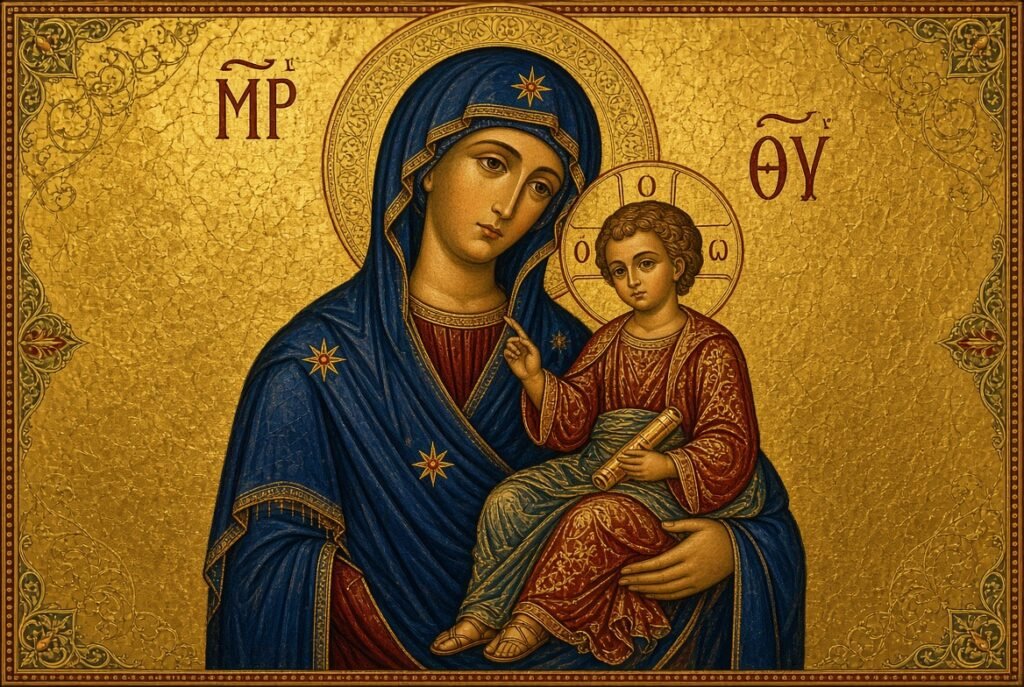
There are moments in the Christian life when a single name carries the weight of the entire Gospel. For us Orthodox, one of those names is Theotokos. It is not a sentimental title. It is a confession of who Jesus Christ is, and therefore a window into the mystery of our salvation. In these reflections I want to linger with her — why the Church insists on calling her Theotokos, what we know of her life from Scripture and Holy Tradition, some of the ways her intercession has been experienced across the centuries, and finally what her presence means for the Orthodox Church and for each of us.
Why “Theotokos”?
The Greek word Θεοτόκος means “God-bearer” or “She who gave birth to God.” It does not mean that Mary gave birth to the divine nature itself, as if the eternal God had a beginning in her womb. Rather, it confesses that the One she carried and bore is the eternal Son of God, the Second Person of the Holy Trinity, who in the fullness of time took flesh from her and became man without ceasing to be God.
This title was not invented at the Council of Ephesus in 431. The Fathers had already been using it for generations. But it was at Ephesus that the Church had to defend it against Nestorius, who preferred the safer-sounding title Christotokos — “Christ-bearer.” Nestorius feared that calling Mary “Mother of God” somehow mixed the divine and human natures. In reality, his language tended to divide Christ into two persons.
Saint Cyril of Alexandria and the bishops at Ephesus saw the danger clearly. If Mary is not Theotokos, then the One born of her is not truly God. The Incarnation collapses. The Council therefore proclaimed that the holy Virgin is Theotokos because she gave birth to the Word of God made flesh. As Saint John of Damascus later wrote, “The name Theotokos contains the whole mystery of the dispensation.”
To call her Theotokos is first and foremost a statement about Jesus. Only secondarily — though still truly — is it a statement of honor toward His Mother. We do not exalt her above her Son; we exalt her because of her Son.
Her Life According to Scripture and Holy Tradition
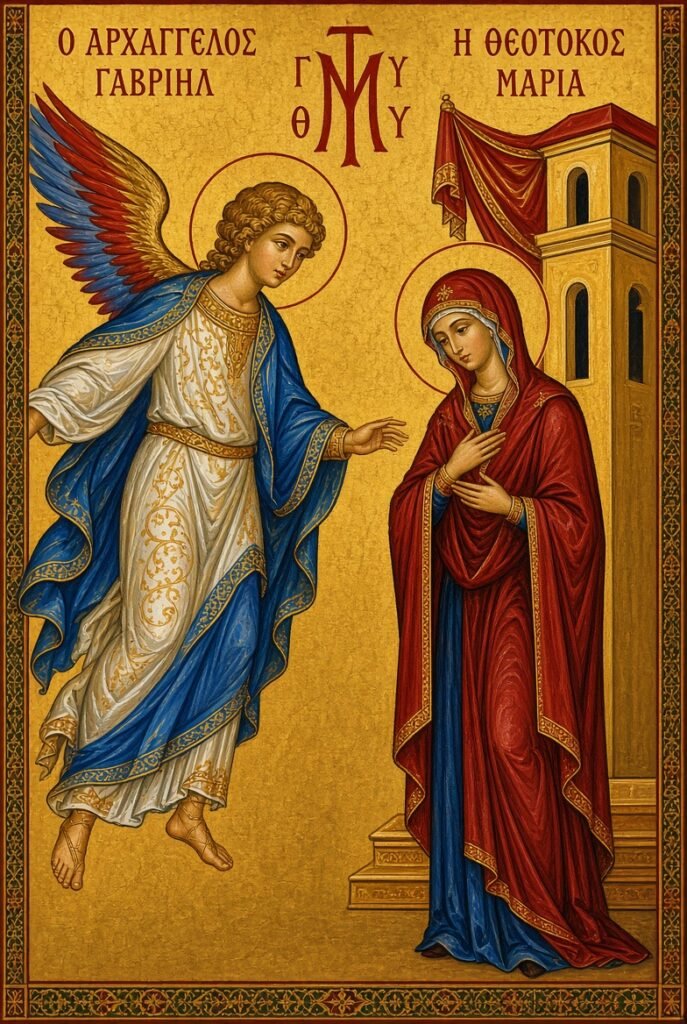
The Gospels give us precious, restrained glimpses of her. At the Annunciation the angel greets her as “full of grace,” and she responds with the words that became the pattern of every Christian life: “Behold the handmaid of the Lord; be it unto me according to thy word.” She visits Elizabeth, and the unborn Forerunner leaps in recognition of the Lord in her womb. She gives birth in the cave at Bethlehem, presents the Child in the Temple, loses Him and finds Him again among the teachers, stands at the foot of the Cross when nearly everyone else has fled, and is present with the disciples in the Upper Room at Pentecost.
Holy Tradition fills out the picture with the reverence of a Church that has never stopped loving her. From the Protoevangelium of James and the consistent witness of the Fathers we learn of her parents, the righteous Joachim and Anna, who received her in answer to long barrenness. At the age of three she was presented in the Temple and remained there until the time came for her betrothal to the elderly Joseph. She remained ever-virgin — before, during, and after the birth of Christ — a truth the Church has always held and which the icons quietly proclaim with the three stars on her maphorion.
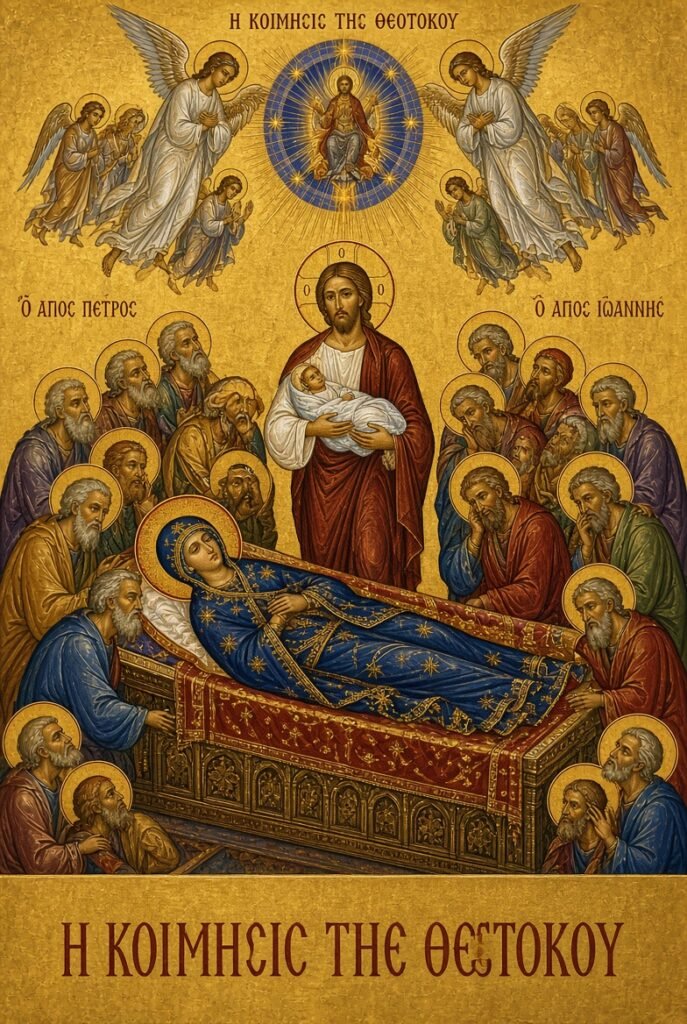
After the Ascension she lived under the care of the Apostle John. Then came the end of her earthly life — the Dormition. The Apostles were miraculously gathered. Christ Himself received her pure soul. Three days later her body was no longer in the tomb; it had been translated to heaven. She already participates in the resurrection that awaits us all.
Her Intercession and the Miracles of Her Presence
The Church has never treated the Theotokos as a figure of the distant past. From the earliest centuries the faithful have experienced her as a living Mother who continues to care for her children.
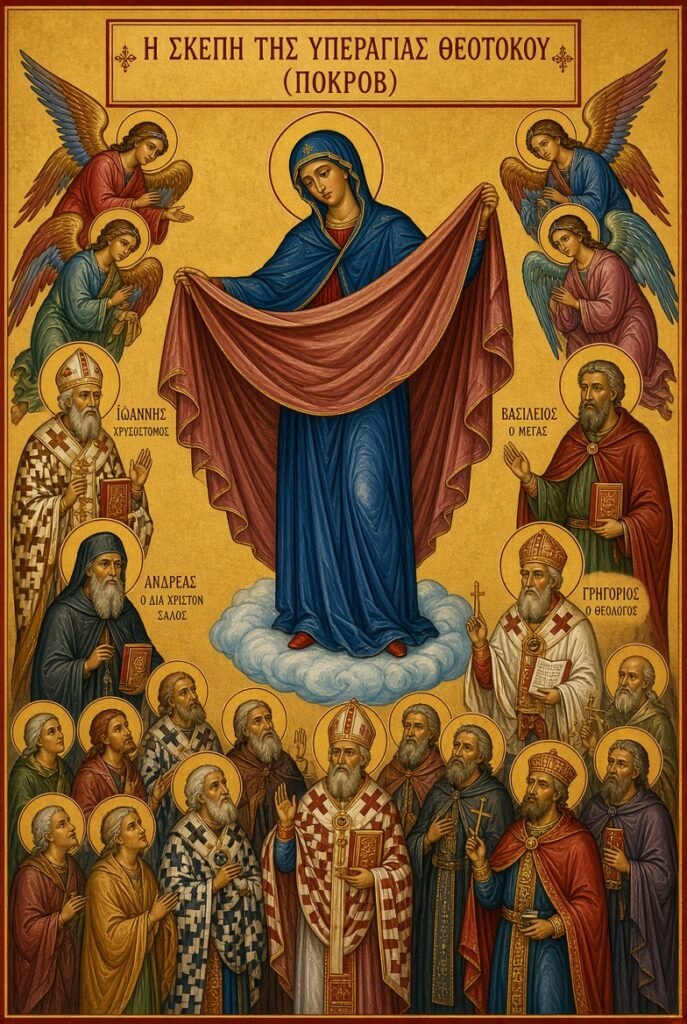
In 626, when Constantinople was surrounded by enemies, the Patriarch processed around the walls with her icon. The city was delivered, and the people spent the night singing in thanksgiving — the origin of the Akathist Hymn. In the tenth century, during an All-Night Vigil in the Blachernae church, Saint Andrew the Fool-for-Christ and his disciple saw the Theotokos appear, remove her veil, and spread it over the people as a protective covering. That vision is the foundation of the Feast of the Protection.
Countless wonderworking icons bear witness to the same maternal care: the Portaitissa of Iveron, the Life-Giving Spring, the Vladimir icon, the “Quick to Hear” of Mount Athos, and so many others. Healings, deliverances, consolations in grief — the stories continue because her intercession is not theoretical. She is the one who stands closest to the throne of her Son and who never tires of bringing our needs before Him.
What She Means to the Orthodox Church
In the Orthodox Church the Theotokos is “more honorable than the Cherubim and beyond compare more glorious than the Seraphim.” We do not worship her — worship belongs to God alone. We venerate her with a unique honor because of the unique place she holds in the economy of salvation. She is the purest fruit of the old covenant, the New Eve who said yes where the first Eve said no, the living Ark that carried the Word.
She is the great example of synergy — the cooperation of human freedom with divine grace. God did not force the Incarnation upon her. He waited for her free consent. In that “yes” the whole of creation found its proper response to the Creator.
She is also our Mother. From the Cross the Lord gave her to the beloved disciple, and through him to all of us. When we pray “Most Holy Theotokos, save us,” we are not asking her to replace Christ. We are asking the one who is closest to Him to intercede for us. Her boldness before the throne is greater than ours, and she uses it on our behalf.
Four of the Twelve Great Feasts belong to her. Her icons surround us in every Orthodox church. Her name is remembered in every Liturgy. This is not exaggeration; it is the natural consequence of taking the Incarnation seriously. If the Word truly became flesh, then the woman who gave Him that flesh cannot be peripheral.
A Final Word
The longer I walk in the Church, the more I understand that love for the Theotokos is not an optional devotion. It is simply part of loving Christ. To know Him is to know the Mother who bore Him, raised Him, stood by Him, and now stands by us.
May we learn from her the humility that says “be it unto me according to Thy word.” May we run to her with the confidence of children who know their Mother will not turn them away. And may we, through her prayers, come one day to the place where she already stands — in the presence of her Son, in the joy that has no end.
Most Holy Theotokos, save us.