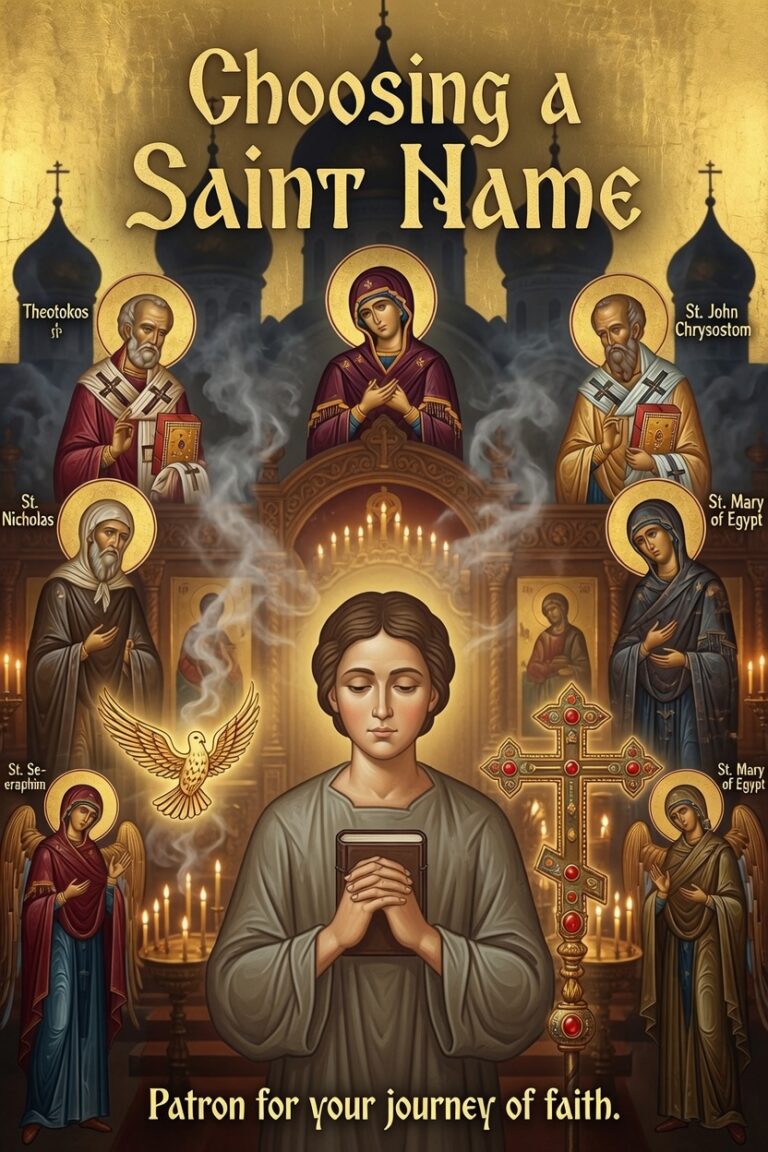
Choosing a saint’s name — whether for baptism or as a patron — is one of the most beautiful parts of entering the Orthodox Church. It isn’t a strict formula or a test you can get wrong. It’s more like being welcomed into a family and discovering which of the saints feels like home. Your patron becomes someone you look up to, someone who prays for you, and the name you’ll hear when you come forward for the sacraments.

Since I was given my name at birth, I had to learn how this works for converts. Here’s the gentle, traditional guidance I’ve seen, though I always encourage people to talk with their priest because every parish and jurisdiction has its own pastoral wisdom.
Ways People Commonly Choose a Patron Saint
1. Looking at saints near meaningful dates
This is one of the oldest approaches. Many people look at the saints commemorated around their birthday, their baptism/chrismation date, or another important moment in their life. Some use a three‑day window around the date. It’s a way of tying your new life in Christ to the rhythm of the Church.
Helpful places to look: the OCA calendar, the Greek Archdiocese saint search, or even a printed Orthodox calendar.
2. A saint you naturally feel drawn to
This is especially common for adult converts. Sometimes a saint’s story, struggles, or personality just resonates. Maybe you read their life and something stirs. Maybe you keep noticing their icon. Sometimes it’s subtle, sometimes it’s immediate — but that quiet pull can be meaningful.
Recently a close friend who is becoming Orthodox asked me how someone chooses a patron saint or a saint’s name. It’s one of those questions that seems simple until you try to answer it. I’m still learning myself, but I shared what I’ve picked up along the way, and I thought it might help others too.
3. A connection to your given name
If her legal name is already the name of an Orthodox saint (or close to one), she can often keep it by choosing a specific saint with that name. If not, some people choose a saint with a similar-sounding name.
4. A saint connected to her life or vocation
Some people choose a saint who reflects something about their journey:
- Martyrs for courage in trials
- Ascetics or theologians for spiritual depth
- Saints tied to their profession, heritage, or personal struggles
Others choose a “pairing” — a saint near their birthday and one they admire deeply.
Practical Steps That Can Help
- Begin with prayer. Ask God to guide the choice. Some people even pray, “If it’s Your will, let this saint draw me closer,” and pay attention to what follows.
- Read the lives of the saints. Start broad, then narrow down to a few who stand out. Books like The Prologue of Ohrid or online synaxaria are great places to begin.
- Talk with her priest. This is important. He may offer guidance, confirm the name, or even suggest one she hadn’t considered.
- Choose a saint of the same gender. This is the usual practice for baptismal names, with only rare exceptions.
A Little Encouragement
- Her saint’s name becomes her Christian name in the Church, but she doesn’t need to change anything legally.
- She’ll celebrate her Name Day, the feast of her saint, almost like a spiritual birthday.
- And it’s okay if she doesn’t feel an instant, dramatic connection. Relationships with saints grow the same way relationships with people do — slowly, through prayer, reading, and simply living with them.
If you want, you could even explore saints together. Share a favorite of yours, look through calendars, or read a few lives side by side. It’s a beautiful way to walk with her as she steps into the Church.
May God bless her journey, and yours as you accompany her.