
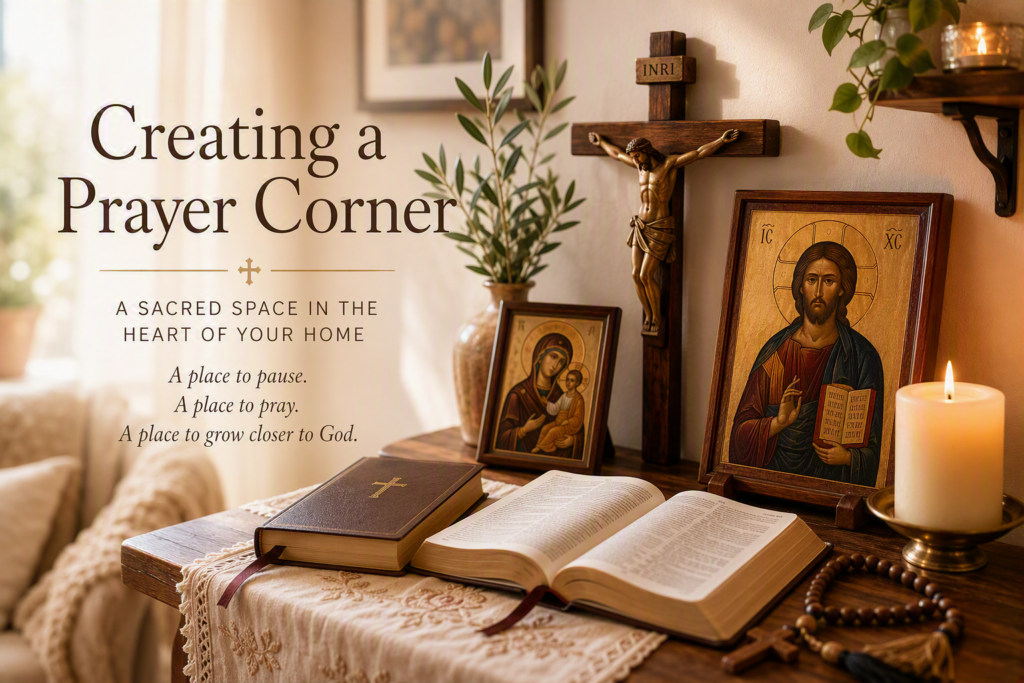
In the Orthodox Christian home, one of the most quiet yet powerful acts of faith is setting apart a small place for prayer. We call it the prayer corner, the icon corner, or sometimes the “beautiful corner.” It is not furniture. It is not decoration. It is a deliberate turning of the household toward God—a little church within the walls where we live, work, eat, and rest.
This space matters because prayer is not meant to be an afterthought squeezed between obligations. The Fathers understood that the body and the place where we stand shape the heart. When we create a dedicated corner and return to it morning and evening, we train ourselves to remember that God is present in the ordinary rooms of our lives. Over time the corner becomes a place of encounter: a steady reminder that Christ, His Mother, and the saints are not distant, but near.
Facing East Whenever Possible
Whenever it can be done, the prayer corner should face east. This is not an arbitrary preference. From the earliest centuries Christians oriented themselves toward the rising sun because Christ is the Sun of Righteousness (Malachi 4:2) and because He will return from the east (Matthew 24:27). The churches themselves are traditionally built with the altar toward the east for the same reason. When we stand in our homes facing that direction, we join the whole Church in looking toward the coming of the Lord and toward the restored Paradise that once lay in the east.
Of course, modern houses and apartments do not always cooperate. If the only true eastern wall is a bathroom door or a closet, do not despair. Choose a quiet, dignified place that you will actually use—living room, bedroom, or even a spare corner that feels set apart. The intention to orient the heart matters more than a perfect compass reading. Still, make the effort if it is possible. Even a slight turn toward the east carries meaning.
How to Create the Corner
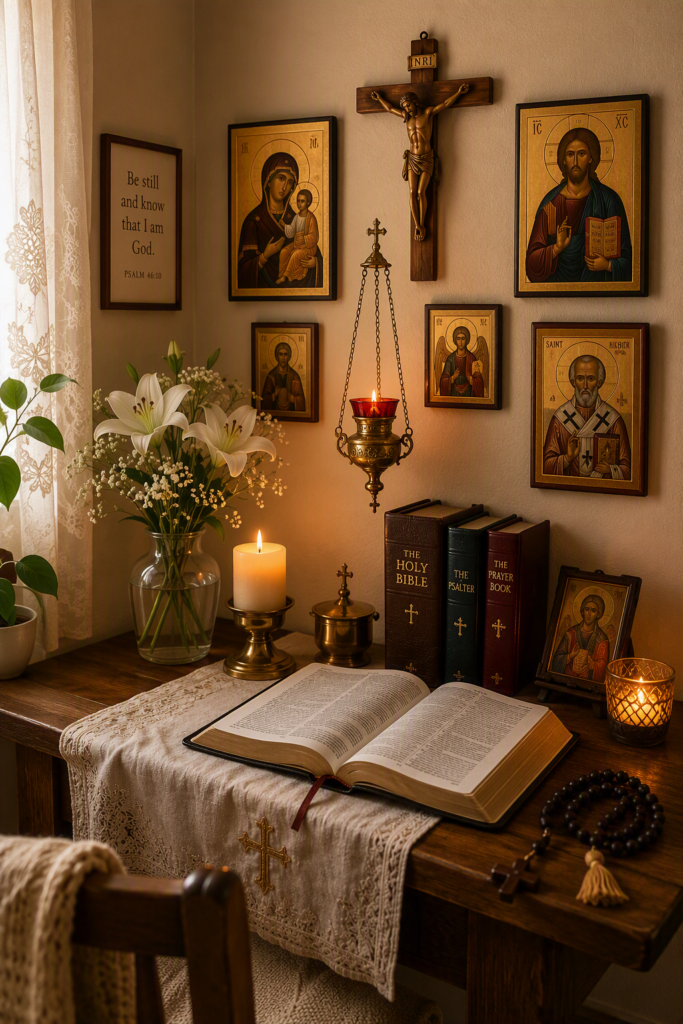
Begin simply. You do not need a museum of icons or expensive furnishings. The essential foundation is an icon of Christ—preferably Christ Pantocrator—and an icon of the Theotokos. Place Christ on the right as you face the icons (the place of honor) and the Theotokos on His left. A cross often stands between them or slightly above. These three form the core of every Orthodox prayer corner because they proclaim the Incarnation and the hierarchy of heaven.
From there you may add icons of your patron saint, the patron of your parish, or other saints who have become dear to you. Never place another icon higher than Christ. The arrangement itself teaches theology every time you look at it.
A small shelf, a table, or even a sturdy wall-mounted board works well. Many families keep a clean cloth beneath the icons. In front of them place a vigil lamp or a beeswax candle. The light is a quiet proclamation that Christ is the Light of the world. You may also keep a prayer book, a small Bible, a prayer rope (komboskini or chotki), and, if you wish, a censer for incense on feast days or when the heart especially needs the image of prayer rising like smoke (Psalm 141). Holy water from Theophany, a bit of blessed oil, or palms from Palm Sunday can find a place here as well, connecting the home to the larger life of the parish.
Start with what you have. One icon of Christ, a candle, and a quiet intention are already a complete and theologically sound beginning. The corner can grow as your prayer life deepens. What matters is not the quantity of objects but the quality of the attention you bring to them.
Why It Matters
A prayer corner does several quiet but profound things. First, it makes prayer concrete. Instead of searching for a vague “spiritual mood,” you stand before faces that have looked upon God and intercede for us. Icons are windows, not idols. We do not worship the wood or paint; we honor the persons depicted and ask their prayers.
Second, the corner gathers the household. Even if only one person prays there regularly, the space itself becomes a silent teacher for children and visitors. It announces that this home has a center higher than television screens or work desks.
Third, it creates continuity. Morning and evening prayer before the same icons day after day forms a rhythm that steadies the soul through ordinary weeks and sudden crises. When trouble comes, you already know where to stand.
How to Pray at the Corner
Light the lamp or candle. Make the sign of the cross. Stand quietly for a moment and let the noise of the day settle. Begin with the usual opening prayers if you know them—“O Heavenly King,” the Trisagion, the Lord’s Prayer—or simply speak to Christ from the heart. Many people use a standard prayer book for morning and evening prayers; others keep a shorter personal rule that includes the Jesus Prayer on the prayer rope: “Lord Jesus Christ, Son of God, have mercy on me, a sinner.”
Pray for the living and the departed by name. Offer thanksgiving. Ask for strength to do the day’s work with honesty and kindness. If you are able, make a few prostrations; the body learning humility helps the soul learn it too. When you finish, extinguish the candle or leave the vigil lamp burning if it is safe, and go about the day knowing you have stood before the face of God.
Consistency is more important than length. Ten focused minutes every morning and evening will do more for the heart than an hour once a week. Speak with your priest about a simple rule that fits your season of life. The corner is not a performance stage; it is a meeting place.
Beginning and Growing
If you do not yet have a prayer corner, choose a spot this week. Hang or place an icon of Christ. Light a candle. Stand there and say the Lord’s Prayer. That is enough for a start. Over months the space will gather the marks of a living faith—worn prayer books, a slightly sooty lamp glass, the faint scent of incense. These are not clutter. They are the quiet evidence that someone in this house is trying to keep the commandments and to remember God.
Ask your priest to bless the icons and the corner when the time feels right. The blessing is not magic; it is the Church’s prayer that this little place would become a true point of contact between earth and heaven.
In the end, the prayer corner is less about the arrangement of objects and more about the orientation of a life. We face east because we wait for the One who is coming. We light a lamp because He is Light. We stand before icons because the Word became flesh and dwelt among us. And every time we return to that corner—tired, distracted, or grateful—we practice the simplest and most necessary work of the Christian: turning toward God and remaining there for a little while.
May your prayer corner become a place of peace, repentance, and quiet joy. And may the Lord who meets us in the smallest spaces of our homes also meet you there.