
Someone told you to come, or you read something that would not leave you alone, and now you are looking at a church with a dome and a schedule board that says Divine Liturgy, 9:30 a.m. and you are trying to decide whether to walk in.
Walk in. That is the whole of the advice. But it is fair to want to know what you are walking into, because if your experience of Sunday morning is a sanctuary with a band, a welcome slide, a forty-minute sermon, and coffee in the lobby, the Divine Liturgy will not feel like a different flavor of the same thing. It will feel like a different thing entirely. Most people who have loved it for decades were bewildered the first time. That is not a defect in you.
So here is what to expect, plainly, from someone who was once the confused visitor in the back.
The Service Has Already Started
If the schedule says Liturgy begins at 9:30, you may find that Matins or the Hours have already been going on for a while. The arrangement varies by parish, and the services may follow one another without much of a break. Check the schedule and aim to arrive a little before the advertised Liturgy time.
You may notice people arriving after the service has begun. That does not mean arriving late is the custom to aim for. If you are delayed, enter quietly and ask someone near the door whether to wait before moving farther in; during the Gospel or a procession, it is often better to stay where you are for a moment.
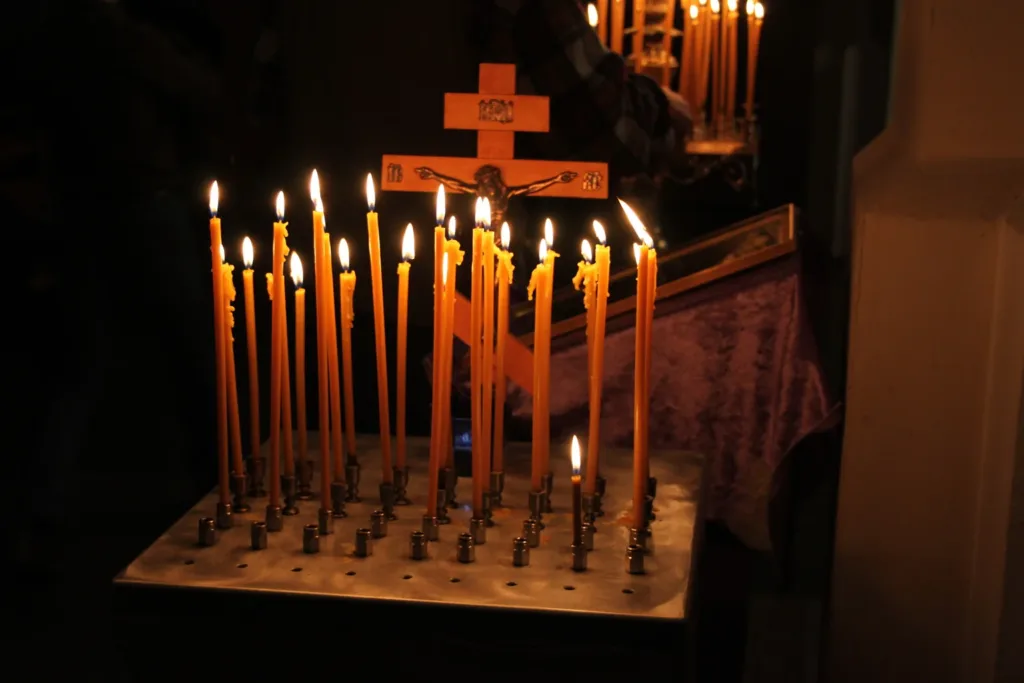
You do not have to light a candle. If you would like to, watch someone else do it first and then do it slowly. Nobody is grading you.
You Will Stand
In many Orthodox parishes you stand for much of the service. The length varies with the day and the parish; allow time rather than relying on a fixed ninety minutes. There are usually chairs or pews, and you should use them if illness, disability, pregnancy, age or simple exhaustion means you need to sit.
Standing is the default posture, and it is worth understanding why rather than simply enduring it. It is a way of being attentive with the body as well as the mind, and it carries the hope of the Resurrection.
I once asked my old priest why we stand. He answered, “Are you going to sit around or stand when you’re judged?”
That stayed with me. Standing says that I am present, listening and ready to answer. But it is not a test of endurance.
The First Council of Nicaea, in canon 20, directed prayer standing on Sundays and during the Paschal season through Pentecost. St. Basil also connected Sunday standing with rising with Christ. That is the tradition behind the posture. It is not an instruction to disregard your body or to correct the person sitting beside you.
In many parishes people stand especially for the Gospel and the central prayers of the Liturgy. Follow the parish’s guidance as you are able.
The first time, you will be tired. Stand as long as you can, sit when you need to, and let that be enough.
What to Do with Your Legs and Hands
When you sit, keep your legs uncrossed if you comfortably can. When standing, let your hands rest naturally at your sides or in front of you rather than holding your arms behind your back.
These are small habits of attentiveness taught in many Orthodox churches. They do not tell you how devout the person beside you is. If a physical need requires a different position, take it. There is no reason to spend the service worrying that you have put an elbow in the wrong place.
Head Coverings
In many parishes women wear a scarf or veil in church. In others, fewer do. It is a customary expression of reverence, not a universal admission requirement for a visitor.
The practice has a Scriptural reason. In 1 Corinthians 11, St. Paul discusses men and women praying, the covering of the head, and the order of worship. Women who cover their heads receive that practice as an act of reverence before God. The same passage also speaks of the dependence of women and men on one another in the Lord.
If you would like to wear a scarf, a simple one is enough. If you arrive without one, do not assume you must turn away. Ask quietly if you are unsure of the parish’s custom; monasteries and particular churches may give more specific directions.
I would not use another woman’s scarf, or its absence, to measure her faith.
There Is No Band
There are no instruments at all, in most parishes. Everything you hear is human voices — a choir, a chanter, sometimes the whole congregation — and nearly the entire service is sung rather than spoken. The priest sings. The deacon sings. The responses come back sung.
You will not know the words, and you will not know the tunes, and the melodies will not resolve the way Western music has trained your ear to expect. Some of it will sound austere. Some of it will sound like it is coming from a long way off. Most parishes have books or pamphlets that follow along; take one, but consider not burying your face in it the first time. Let it wash over you and look around instead. You can study the text next week.
When Someone Says “Christ Is Risen!”
From Pascha until Ascension, you may be greeted with “Christ is risen!” The answer is “Indeed He is risen!” or “Truly He is risen!” Both are used.
The priest may call it out during the services, and the people answer together. You do not have to wait until you know every hymn to join that greeting.
It is a small exchange, but it says what the whole season is about.
The Liturgy Is the Point, Not the Sermon
This is the deepest difference, and it is worth saying directly.
If you come from a low-church background, the architecture of Sunday morning is built to deliver a sermon. Music warms the room, announcements handle business, and then a man opens a Bible and teaches for forty minutes, and that teaching is the substance of the hour. The rest is the frame around it.
In the Divine Liturgy, the homily may last eight minutes. It might be excellent. It might be a priest with a cold reading from notes. Either way, it is not the center, and its length is not a measure of how good the service was. The center is the offering — the Church gathered, doing the thing she has done since the beginning, giving thanks and receiving the Body and Blood of Christ. The Liturgy is the Church’s common worship. You are not in the audience. You are in the room where the work is being done.
This takes a while to feel rather than merely understand. Give it more than one Sunday.
Icons, Incense, and East
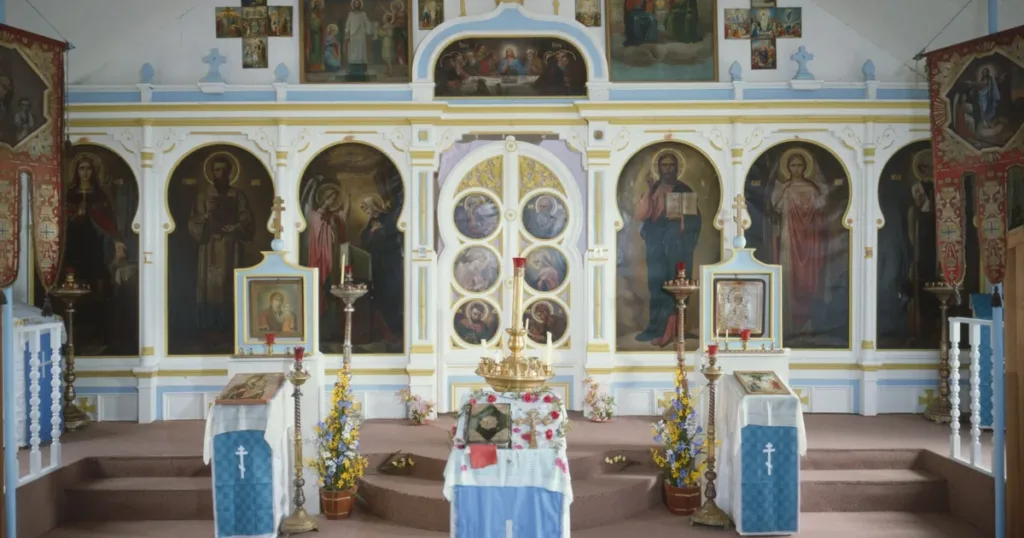
The walls will not be bare. Icons will be everywhere, and across the front of the church stands the iconostasis, a screen of icons with doors in it, through which you will catch glimpses of the altar. The censer will come out, and the smell of incense will get into your coat and ride home with you.
The priest, for much of the service, faces away from you. This unsettles some visitors who read it as the pastor turning his back on the congregation. It is the opposite. He faces east, as the people do, because he is not performing toward you — he is praying with you, at the head of the procession, toward the rising sun and the Christ who comes from the east. We are all facing the same direction.
You will also cross yourself, if you cross yourself at all, differently than you may have learned: right shoulder first, then left. If you are not Orthodox and would rather not, simply stand quietly. Copy nothing you do not yet mean.
And in most parishes the cross does not travel alone. It is often followed by a bow — the hand comes down, the body bends from the waist, and the fingers touch the floor. This is a metania, from the Greek word for repentance, and it is what people mean by a half prostration. You will see them at particular moments rather than at random, and once you notice the first one you will start seeing them everywhere.
There is also the full prostration, where a person goes all the way down, knees and forehead to the floor, and rises again. That one mostly belongs to Great Lent, and especially to the weekday services — the Presanctified Liturgy, and the Prayer of Saint Ephrem, where the whole church goes down and up together. It is a remarkable thing to walk in on.
Sunday has a different character from a Lenten weekday. The standing tradition described above expresses the joy of the Resurrection, so you will usually see fewer prostrations at an ordinary Sunday Liturgy.
But not every going-down is penitential, and there are Sundays in the year when the church goes down together. The clearest is the Third Sunday of Great Lent, when the Cross is carried out into the middle of the church and venerated — the hymn is “Before Thy Cross we bow down in worship, O Master, and Thy holy Resurrection we glorify,” and it is sung with prostrations. That is veneration, not mourning, which is why it belongs on a Sunday. There is also the Kneeling Vespers of Pentecost, served in most parishes right after the Liturgy, where three sets of long prayers bring the congregation to its knees for the first time since Pascha. Fifty days of standing, and then everyone kneels at once.
Beyond those, practice genuinely varies. Parishes differ, jurisdictions differ, and some American parishes kneel at the consecration out of long habit whatever the canon says. Nobody stands at the back taking names. Do what the people around you are doing, or do nothing at all, and let it go. If you are curious why a particular parish does a particular thing, that is a question for the priest at coffee hour, and he will likely enjoy it.
You Will Hear a Great Deal About the Theotokos
Theotokos means “God-bearer,” and it is what Orthodox Christians call the Virgin Mary. Her name will come up constantly — in the hymns, in the litanies, at the close of nearly every set of petitions.
Be honest: to a Protestant ear on a first visit, this will sound like Mary is being worshiped. Nearly every convert has thought exactly that. The short answer is that the title is a statement about Christ before it is a statement about Mary — it insists that the one she bore was God, truly and from the first moment, and the Church fought hard for that word. The longer answer takes months and belongs to conversations with a priest and to reading done slowly. For a first Sunday, it is enough to notice your discomfort, set it on the shelf, and not decide anything yet.
The Chalice Is Closed, and the Bread Afterward Is Not
Near the end, the faithful come forward to receive Communion from a golden cup with a spoon. If you are not Orthodox, you do not approach. This is not a snub and it is not a judgment of your faith, and it will still probably sting a little the first time.
The reasoning is this: for the Orthodox, Communion is not a memorial the individual takes for himself but the Body and Blood of Christ received within a shared life — a common faith, a common confession, a common discipline of preparation, fasting, and confession with one’s priest. Receiving together is the sign that all of that is already shared. It is the family meal at the end of the road, not the handshake at the beginning of it.
There is good news at the end, though. At the close of the Liturgy, most parishes give out antidoron, blessed bread left over from the loaf used in the offering. It is blessed bread, not the Eucharist. Don’t be surprised if a parishioner notices you and brings you a piece. It is the Church’s way of saying that you are not outside the door.
Then There Is Coffee
Here is the part the visitor guides bury at the bottom.
During the service, you may not be greeted immediately. Some parishes have someone near the door to help visitors; others are quieter about it. There may be no formal welcome moment. Do not judge the whole parish by those first few minutes: attention is on the worship, and conversation usually comes afterward.
In many parishes, coffee hour follows in a hall or another room. If it is offered, go, even if you feel conspicuous or had planned to slip out to the car. Take a cup of coffee and introduce yourself. You may find the conversation begins easily; if it does not, telling someone that this is your first visit is a good beginning.
If the priest is available afterward, introduce yourself and say you are visiting. You can tell him that you did not understand most of it. If he is occupied, ask how to arrange a conversation another time.
A Short List for the Morning
Aim to arrive a little early. If you are late, enter quietly and follow any guidance at the door. Choose a place where you can see without blocking the way. Stand when others stand as you are able, sit when you need to, and do not worry about getting every movement right. If you are not Orthodox, stay in your place at Communion; accept antidoron if it is offered, and stay for coffee if there is a gathering afterward. Do not try to follow every word. Do not decide anything on the drive home.
And do not expect to be moved. Some people weep at their first Liturgy and some people spend the service wondering when it will end and what on earth they have gotten into. Both of those are ordinary. The Liturgy is not a performance designed to produce a feeling in you on a schedule; it is a house you are standing in for the first time, and houses take a while to become familiar.
What You Were Standing In
One thing to carry out to the car with you.
Around the year 150, a Christian named Justin wrote to a Roman emperor to explain what these people actually did when they met, because the rumors going around were ugly and he wanted the record straight. He described a gathering on the day of the sun. Readings from the prophets and the apostles. A sermon urging the people to do what they had just heard. Prayers offered standing. Bread and wine brought forward. A long prayer of thanksgiving over them, with the people answering Amen. The gifts distributed, and deacons carrying a portion to those too sick to come. A collection taken for orphans and widows and strangers.
That is the service you just attended, in that order, on that day of the week. You could hand Justin this morning’s bulletin and he would know where he was.
It would not be true to say nothing has changed since then. The Liturgy grew. The Creed was not sung in it until around the turn of the sixth century. The hymn the choir sang while the gifts were carried in entered the service in the 570s, under an emperor named Justin II. The prayers themselves carry the name of Saint John Chrysostom, who reposed in 407. Things were added, and the shape settled, and the Church argued about all of it at the time.
What is true is better than unchanged, and quieter. The service grew mostly by addition. Hymns and prayers were layered onto a shape that was already there, and that shape held — the readings, the homily, the offering, the thanksgiving, the Amen, the sharing out. Eighteen centuries of people kept standing in it rather than starting over, and this morning you were one of them.
Come back. That is the only real instruction. It makes a different kind of sense the third time, and a different kind again the twentieth, and the people who have been there forty years will tell you it is still opening.
May the Lord bless your coming in and your going out, and may you find, in that room full of candles and smoke and unfamiliar singing, that you were expected.