
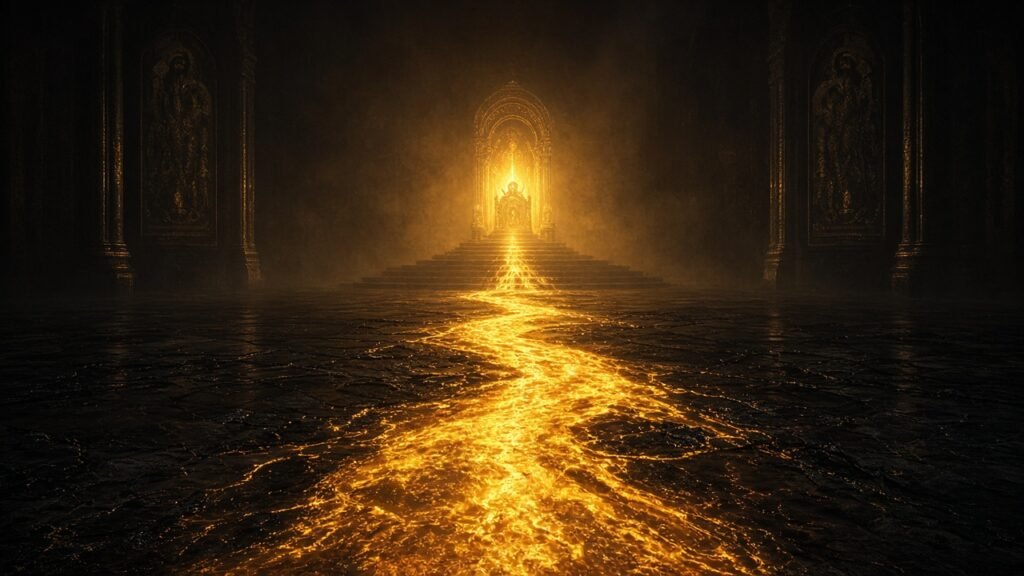
I’ve sat with that Last Judgment icon longer than I’ve admitted in polite company. Christ on the throne. The blessed on one side, the ones who spent their lives against Him on the other — even the ones who looked pious. And between them, coming out from the throne, a river of fire.
Most people flinch at that river. They’ve been taught to read it as God’s torture tool — the moment Love puts on a badge and starts handing out sentences. I understand the flinch. I grew up around Western Christianity before I found my way into Orthodoxy. The angry Judge is a hard picture to shake.
But that wasn’t the only water I drank. I also grew up around priests and seminarians who put books in my hands that a lot of Western — and Eastern — Christians would call out of bounds. The Book of Enoch was one of them: throne, rivers of fire, holiness that purifies. Same circles talked a lot about God’s eternal love and forgiveness. The pitch was simple: just ask, and you’re instantly forgiven. Clean slate on demand. No struggle, no tears, no long repentance — punch the prayer button and move on.
I am grateful they opened Enoch for me. I am less grateful for how thin “forgiveness” can get when it costs nothing. I have always felt close to the Creator. I have always sought truth and asked too many questions. That hunger is why cheap answers never sat right — neither the angry Judge with a furnace nor the soft uncle with a stamp that says FORGIVEN.

Then I read Alexandre Kalomiros’s essay The River of Fire. He isn’t a priest — a Greek Orthodox layman, a physician who wrote theology like a man who’d actually been afraid of God and then found something better. He looks at that same icon and asks a simple question: what if the river isn’t vengeance? What if it’s love?
That stopped me.
Kalomiros’s claim is blunt. Paradise and hell are not two different neighborhoods God builds depending on His mood. They are two experiences of the same reality — the outpouring of God’s love, the fire that is God Himself. “Our God is a consuming fire,” Scripture says. Love is fire. Anyone who has loved hard enough already knows that.
If your heart is turned toward Him, that fire is light, warmth, joy — the water of life. If your heart is clenched against Him, that same fire is torment. Not because God switched off mercy, but because hatred cannot bear Love when there is nowhere left to hide. A diseased eye suffers the same sunlight that makes a healthy eye glad. A son who loves his father rests in his father’s arms; a son who hates him finds those same arms unbearable.
That is not soft religion. That is terrifying in the right way. It means the problem is not that God might stop loving you. The problem is what you have become if His love feels like death.
I don’t treat Kalomiros as the only Orthodox word on the subject. Some serious voices push back hard — they say the Fathers also speak of real judgment and that he sands the edges off. Fine. Read the critics. I’m not asking anyone to make one modern essay into a fifth Gospel. I’m saying this reading unlocked the icon for me without turning God into a monster or sin into a joke.
And here’s where my own reading leans in.
Enoch isn’t on every Orthodox shelf. The Ethiopian Orthodox Tewahedo Church kept 1 Enoch — and Jubilees — in its wide scriptural tradition when much of the Mediterranean church let them go. Jubilees is an incredible book too; go figure. Elsewhere, Enoch was often “too far out,” and Jubilees could sit awkwardly beside Genesis — hard for bishops who wanted one coherent story for young and illiterate believers. Ethiopia chose depth. Other churches chose a tighter fence. I understand both instincts. I still open Enoch.
The way I learned those throne-rivers, the fire is purity. God’s own nearness. Fire purifies. It does not need to be rebranded as a separate punishment machine to be serious.
I will not pretend Kalomiros footnoted Enoch on every page. He hangs his essay on the Judgment icon, the river from Eden, the Fathers — Basil especially. But I would bet my sweet seat that this is the same family of images: throne, fire, glory that either brightens you or burns you. When I read Kalomiros, I hear Enoch. When I read Enoch, I see the icon. That through-line is mine to own as a writer, not a fake academic claim.
St. Paisios of Athos is someone I love — who he was, the weight of that life. I won’t invent a Paisios lecture on Enoch’s rivers to prop up my essay. What I take from elders like him is simpler: holiness is not a theory. Stand before God as you are. Repent. Don’t decorate your hatred and call it religion.
Because that is the other edge of Kalomiros’s knife. The people on the left of the icon are not only the obvious villains. They can be the ones who looked reverent while their hearts hated Love. Fire does not grade your performance. It reveals what you wanted.
I am Eastern Orthodox. I am also a man who spent twenty years in a steel tube under the ocean and still believes words should mean something. So I will say this plainly:
If hell is only God finally getting even, then the Cross starts to look like paperwork. If hell is what hatred feels like when Love fills all things and there is no escape into the devil’s temporary shadows — then the Cross is medicine, and the Christian life is learning to become fire without being destroyed. Not by hype. By repentance, prayer, the Mysteries, the long slow work of a heart that stops punching at God.
Does that make judgment “nice”? No. The river still flows. The icon still divides. Nobody slides into paradise on a technicality — and nobody gets there by a one-sentence prayer with no repentance behind it. But the divide is not God inventing cruelty. The divide is whether we have consented to be loved.
Young people — and plenty of old ones — walk away from “God” because the only God they were sold was a cosmic prosecutor with a furnace. Others stay childish because the only God they were sold never burns anything. I do not blame people for refusing the first idol. I do not admire the second. Orthodoxy, at its best, points at the throne and the fire and says: this is Love. Become the kind of person who can live in it.
Kalomiros ends up somewhere near that. Enoch’s vision sits behind my eyes when I look at the icon. Paisios sits in my conscience as a reminder that soft words without struggle are just noise.
So when I look at the river of fire now, I do not first ask, “How do I dodge God’s anger?” I ask, “What in me still hates the Light?” That is a harder question. It is also a more honest one.
The fire is coming either way. Not because God is small. Because God is God — and Love, when it is finally everywhere, will not negotiate with our refusal forever.
Lord, have mercy. Make me the kind of man who can stand in the river and shine.