
A dear friend’s father died last night. She has been my wife’s best friend since they were children. They still are. News like that does not stay in one house. It comes into yours, and if you have lived long enough, it does not surprise you so much as it settles, and you find yourself thinking again about the hour that is coming for all of us.
In the Orthodox Church we do this a little differently. Not because we love death. Because we refuse to pretend the body is leftover packaging, and because we refuse to say that love ends at the grave.
We do not say, first, that a person is gone. We say they have fallen asleep in the Lord. That is not a polite way of dodging the fact. It is the same language the Gospel uses for the dead girl Christ took by the hand, and the same hope we sing at the Dormition of the Theotokos. Sleep is something you wake from. The Church is waiting for a waking.
Other Christians have a wake, a service, a grave, a meal. So do we. The shape looks familiar. The meaning is thicker. We pray for the departed, not only about them. We keep the body in view. We come back on the third day, the ninth, the fortieth, and the years after that. Memory Eternal is not a caption. It is a request.
What follows is the ordinary path. Parishes differ. Greek practice and Slavic practice use different names for the same mercy. What a village family once did with their own hands, a funeral home may still do in this country — or the parish itself, if it has kept the old training. The bones of it are the same.
Preparation of the body
The body is washed and dressed. That used to be the family’s work, and in a village it still may be. In this country a funeral home often takes it, and the priest still comes. That is not the whole picture anymore. In more and more Orthodox parishes — including mine — the church has several men and women trained in the old ways: oils, prayers, the washing and the dressing. They prepare the body. Normally there is no embalming.
Decent clothes. Often a cross or a small icon at the hands. In some places a white garment, recalling baptism. In some places a paper chaplet across the forehead. The casket is commonly left open. Visitors who are not used to that should know it is not theater. These remains were baptized, chrismated, and fed at the chalice. We do not hide them as if they had become an embarrassment.
If there is time before death, the priest is called for confession, Communion, and the prayers at the parting of the soul from the body. If there is not time, the Church still begins. We do not wait for a convenient Saturday.
Before the funeral
The first gathering is often the Trisagion — “Holy God, Holy Mighty, Holy Immortal” — at the funeral home or at the church, the evening before. Family and friends stand there and say the same words they will say again at the grave and again in forty days.
In Slavic usage the Psalter may be read beside the body. In the OCA, more and more — including in my parish — that watch is a vigil: volunteer parishioners stand at the entrance of the church and chant the Psalter and the other prayers all night, until the Liturgy begins. We are not trying to be original. We are trying to keep watch.
The funeral
The funeral itself is in the church, with the body present. In much of Greek practice it is the Funeral Service, about an hour: psalms, the hymns of St. John of Damascus, a reading from St. Paul, a Gospel of resurrection, a homily. Some traditions serve the Divine Liturgy that morning as well. If you are not Orthodox, come. Stand. You do not go forward for Communion. Near the end, people file past for the last kiss. You may kiss the icon on the breast, touch the edge of the casket, or bow from where you stand. Nobody is taking attendance.
Then the priest anoints with oil and with earth in the sign of the Cross. Wash me and I shall be whiter than snow. The earth is the Lord’s. You are dust, and to dust you shall return. Stark, and not cruel. The body is going into the ground on purpose, because we expect to get it back.
The burial
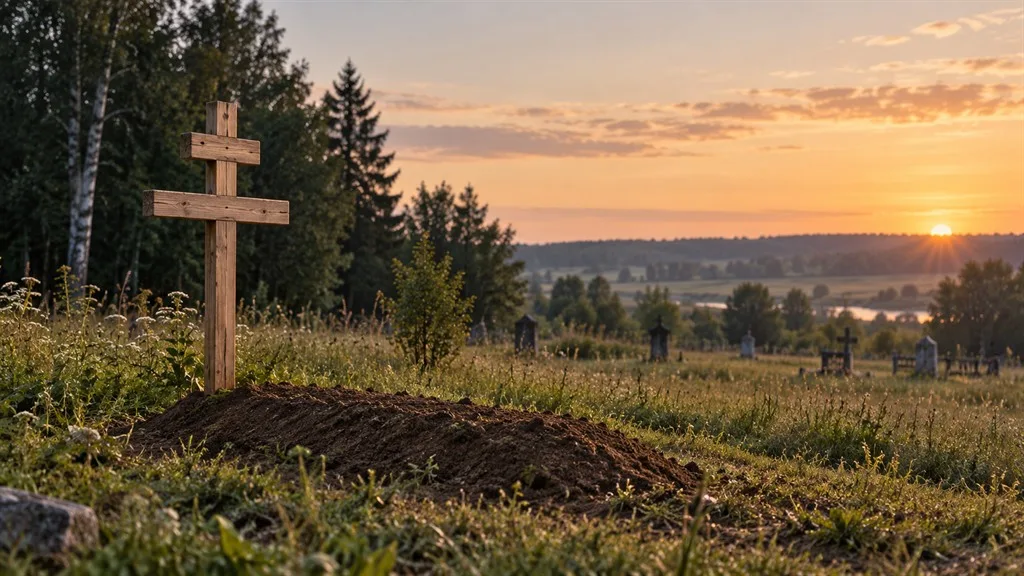
At the cemetery there is another Trisagion. The grave is a sleeping place — that is what the word means. The Church asks for burial, not cremation, because this body is promised a resurrection, not a disposal. A handful of earth. Sometimes oil, wine, a little of the memorial wheat. Then the meal of mercy, the makaria, where people eat because the living still have to, and because grief that never sits down at a table becomes a private religion.
After the burial, and the years after
The funeral is not the last prayer.
Memorials are offered on the third day, the ninth, and the fortieth, and again at a year, and often on the anniversary after that. The numbers are old. The third day has always been referred to Christ’s rising. The fortieth, to the forty days before the Ascension. Families bring koliva — boiled wheat, sweetened — because a grain of wheat falls into the earth and does not stay there. The names of the departed are also remembered at the Divine Liturgy, quietly, in the preparation of the gifts, for as long as anyone still says the name.
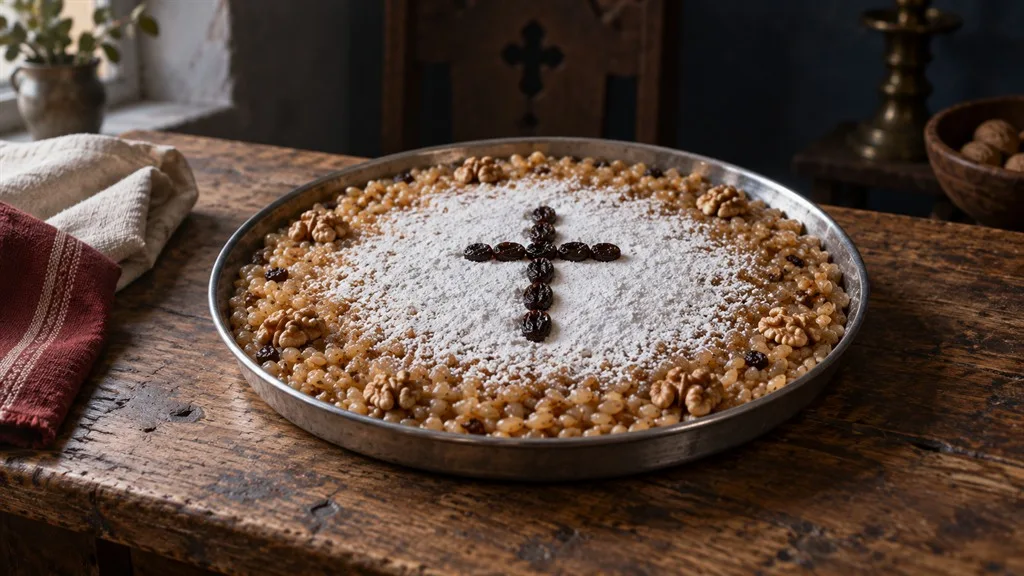
Some light a lamp. Some visit the grave. Some wear black for forty days. None of that is the whole of it. The whole of it is that the Church does not stop speaking the person’s name as if the conversation were over.
The old country, and what is hearsay
In the old world, people were often buried in the churchyard, on family land, or in the village cemetery, facing east, waiting for the last trumpet. A field someone loved is a human wish. A consecrated grave is the Church’s ordinary answer.
What you may have heard about seven years later is real in some places and not a universal Orthodox rule. In many Greek cities the graves are rented. After three years — sometimes longer, sometimes seven, depending on the cemetery — the bones are taken up, washed, and placed in an ossuary, an osteophylakion. Monasteries on the Holy Mountain have done this for centuries: a wooden cross, then the bones gathered into a common house of rest. The priest may serve a Trisagion. The bones are not trash. They are still someone.
Taking a small bone home, as a kind of family relic, is something people tell. I have heard it too. I cannot treat it as the Church’s teaching. Relics of the saints are another matter: the Church venerates those openly. Civil law in some countries will not let remains leave the cemetery at all. If a family kept something in the house, that was local custom, not a rubric you will find in the service book. It is honest to say so. Hearsay should stay hearsay until a priest who knows that village says otherwise.
What is in the book is simpler, and harder, and better: we wash the body, we pray, we bury, we come back. We call death a falling-asleep because we are waiting. We keep the name in the Church’s mouth because God does.
Memory eternal. The bodies matter. Prayer is the least we owe — and, on a night when a friend’s father has died, it is also the most we can actually do.
Related prayers and guidance: Prayers for the Departed · Departing and Remembrance