
I first learned the Creed in Latin, as an altar boy in the Catholic Church in the early 1960s, before the Second Vatican Council began changing things. The priest faced the altar, the same direction as the people. There were four of us boys, two servers and two side servers, and we spent most of the Mass kneeling on the steps behind him. At one point, I think it was during the Creed (it was a long time ago), we boys went down flat on those steps.
Credo in unum Deum, Patrem omnipotentem, factorem caeli et terrae. I could say it long before I understood a word of it.
Years later I heard it again in an Orthodox church, in English this time, because the Orthodox Church almost always prays in the language of the people. And it came with three words missing. Those three words are a story for later in this series.
If you are new, you will have your own version of that moment. Somewhere in your first few months, usually standing, usually without a book, you will realize that everyone around you knows a long prayer by heart and you do not. I believe in one God the Father Almighty, Maker of heaven and earth, And of all things visible and invisible. It goes on for a while. People say it without looking at anything, the way you say your own address.
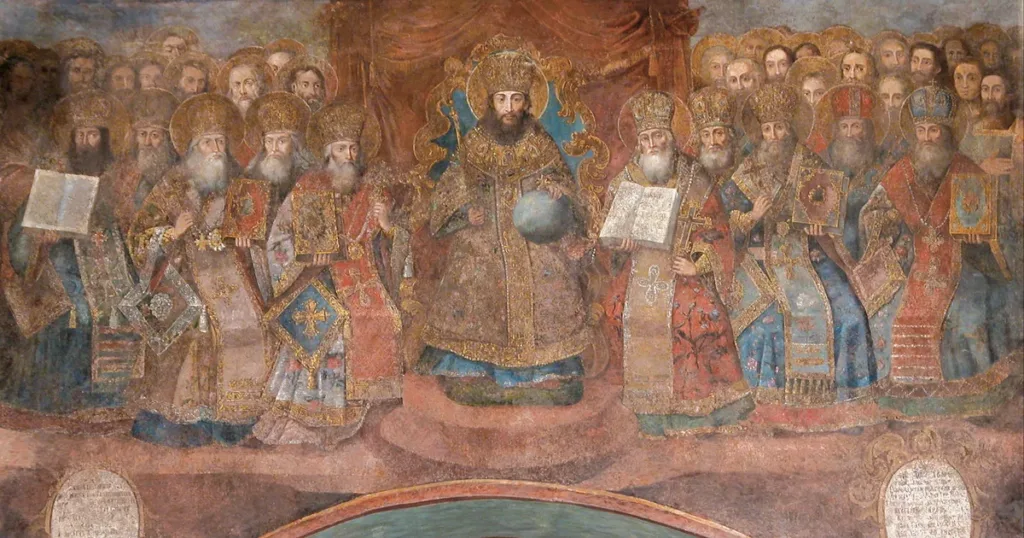
That is the Creed. And nearly every word of the first half of it was fought over, out loud, by a room full of bishops in the summer of 325.
This is the first in a series on the seven Ecumenical Councils. They can sound like the dustiest corner of Church history — old men, old arguments, Greek words nobody uses. I want to try to show you why they are not. Each one was the Church answering a single question that, if it had been answered wrong, would have left us with a different faith. Not a slightly different one. A different one.
A short note at the end explains how I handle the places where tradition and the historians tell it differently. It is worth reading.
The first question was simple to ask and enormous to answer: Who is Jesus Christ?
A Priest in Alexandria
The trouble started, as trouble often does, with a gifted preacher.
His name was Arius, a priest in Alexandria, in Egypt, sometime around the year 318. By every account he was serious, disciplined, and popular. He also had a way with a tune; he set his teaching to verse so that sailors and dockworkers could sing it, which is a very effective way to spread a theology and a very hard way to stop one.
What Arius taught sounded, at first hearing, almost reverent. God is one, he said, and God is unbegotten. The Son is begotten. So the Son must have had a beginning. He is the first and greatest of all God’s creatures, the one through whom everything else was made — but a creature all the same. His slogan, the line that made it into every account, was this:
There was when He was not.
It is worth slowing down here, because Arius was not a fool and his idea was not obviously crazy. He was trying to protect something real: the oneness and the transcendence of God. To many people it sounded like humility. Surely, they thought, it is more respectful to God the Father to keep the Son a step below Him.
His bishop, Alexander, did not think so. And standing beside Alexander was a young deacon named Athanasius, who would spend the next fifty years of his life explaining why.
Why It Mattered So Much
Here is the heart of it, and it is the part that is easiest to miss.
If the Son is a creature — even the highest creature, even the one through whom the stars were made — then He cannot save you.
That is not a technicality. The whole Christian claim is that God Himself came to us. That He took on our flesh, entered our death, and broke it open from the inside. Only God can unite humanity to God. A creature, however exalted, can bring you a message from God. He cannot bring you into God. Athanasius would later put it in a sentence the Church has never stopped quoting: He became man so that we might become god. Not God by nature — we remain creatures forever — but filled with His life, the way iron left in the fire glows with the fire’s heat.
If Arius is right, that sentence is false. Salvation becomes something done for you by a very great go-between, rather than God Himself reaching down and taking hold of you. The worship changes too. If the Son is a creature, then every hymn sung to Christ is a hymn sung to a creature, and the Church has spent three centuries worshipping something that is not God.
So the question was not abstract. It was: is the One we pray to, the One in the icon, the One in the Chalice, God or not?
The Emperor Calls a Council
The argument did not stay in Alexandria. Bishops took sides across the East. Letters flew. Congregations split. And all of this landed on the desk of a man who had only recently stopped persecuting Christians and started favoring them: the Emperor Constantine.
Constantine wanted peace in his empire, and he was beginning to see that a divided Church meant a divided empire. So in 325 he did something no one had ever done. He summoned bishops from across the whole Christian world to meet in one place, at his own expense. He put the imperial post at their disposal — horses, mules, carriages, all paid for by the state. The place was Nicaea, a lakeside city in what is now northwestern Turkey.
An old Greek priest put it differently in a catechism class I sat in. The bishops, he said, were given a choice about whether to come, but they were coming either way. Then he told us the story: Constantine sent soldiers to escort them, and any bishop who declined the invitation was put in the wagon and taken to Nicaea anyway. Everyone laughed. No ancient source says so; Eusebius, who was there, describes warm letters of invitation. But anyone who has ever tried to get a room full of bishops to agree on a meeting will understand why the story is still told.
How many came is not certain. The contemporary estimates run from about 250 to 300. The Church remembers them as the 318 Fathers of Nicaea, the same number as the servants Abraham took into battle in Genesis, and that is the number you will hear in the hymns.
That same priest, once the laughter died down, made sure we understood that the next part was no joke. It was entirely true.
Picture the room. These were not comfortable men. Some of them had come straight out of the persecutions. There were bishops missing eyes, bishops with crippled hands, bishops whose legs had been hamstrung for refusing to deny Christ. The historians say Constantine kissed the scars of some of them. A generation earlier the empire had been trying to kill these men. Now it was paying for their travel.
The Church also remembers two saints at Nicaea with stories attached. St Spyridon of Trimythous, a shepherd-bishop from Cyprus, is said to have taken a brick in his hand to show how three things could be one — and as he spoke, fire went up from it, water ran down, and clay was left in his palm. And St Nicholas of Myra, the same Nicholas, is said to have become so angry listening to Arius that he struck him across the face. You should know that both stories come to us from later tradition rather than from the records of the council itself. You should also know that most Orthodox children hear the one about Nicholas sooner or later, and are delighted by it.
One Word
The bishops quickly agreed that Arius was wrong. The hard part was saying so in a way he could not slip out of.
Every phrase from Scripture they proposed, the Arian party found a way to accept. The Son is from God? Yes, they said; so are we all. The Son is the true image of the Father? Yes; so is man made in God’s image. The Son is God? Yes, in a sense. Every biblical phrase could be stretched, and they stretched it.
So the council did something bold. It reached for a word that is not in the Bible, a word that left no room to stretch: homoousios. It means of one essence — the same being, the same nature, not merely a similar one. The Son is not a lesser copy of the Father. Whatever the Father is, the Son is, except that the Father is Father and the Son is Son.
That is the line you say every Sunday: Being of one Essence with the Father; By whom all things were made.
And around it the council built the rest. Listen to how the Creed piles phrase on phrase, as if closing every exit: the only-begotten Son of God, Begotten of his Father before all worlds; Light of Light, Very God of very God, Begotten, not made. Each of those was aimed. Before all worlds answers “there was when He was not.” Begotten, not made answers “He is the first of the creatures.” Very God of very God (“very” here is the old word for true) answers “He is God in a manner of speaking.”
When you say it, you are standing where those bishops stood.
Nearly all of them signed. Arius did not, and neither did two bishops from Libya who stood with him. They were sent into exile.
What Else Nicaea Did
The Creed was the main work, but not the only work. The council also issued twenty canons — rules for the life of the Church — and some of them you can still see on any Sunday.
It agreed that all Christians everywhere should keep Pascha on the same Sunday, rather than each region working out its own date. The detailed tables came later, but the principle was settled there: one Church, one Feast of feasts.
It recognized the long-standing leadership of the great churches of Alexandria, Rome and Antioch over their regions.
And in its very last canon, it said that on Sundays and through the fifty days from Pascha to Pentecost, Christians should pray standing rather than kneeling. If you have ever wondered why the kneeling stops after Pascha and comes back at Pentecost — that is Nicaea, still at work, seventeen centuries later.
What Nicaea Did Not Do
Because Nicaea is famous, it collects stories, and a few of them you will almost certainly hear.
The Church began at Nicaea. It did not. The Church began at Pentecost, when the Holy Spirit came down on the apostles, nearly three hundred years earlier. By 325 there were bishops in every city, the Liturgy was being served, and the room at Nicaea was full of men who had the scars to prove how long the Church had already been around. Nicaea was not even the first council. The apostles met in Jerusalem to settle a hard question in Acts 15, and Nicaea followed their example, only on a larger scale.
What Nicaea did do was put the Church’s order in writing for the whole world at once. Its canons said a new bishop must be consecrated by at least three others, that the bishops of each province should meet twice a year, and how the great churches stood in relation to one another. But listen to how one of those canons begins: Let the ancient customs prevail. The council was not inventing an organization. It was writing down, for everyone, the one the Church already had.
Constantine founded the Church. He did not. He called the council, paid for it, and opened it, and he wanted very much for the bishops to agree. But he did not write the Creed, and he did not decide what Christians believe. He was not even baptized until he was dying.
Nicaea decided which books belong in the Bible. It did not. Nothing in the council’s Creed, its canons, or the accounts of the people who were there says a word about it. That story is modern, and it has been told so often, in so many novels and documentaries, that people assume it must be true.
And one more, for anyone who arrived from the West, as I did: at Nicaea there was no “Orthodox” and “Catholic.” There was one Church, East and West together, and the bishop of Rome sent two priests to represent him. The sad separation came centuries later. Nicaea belongs to both, and that is worth remembering on both sides.
It Did Not End There
I would be telling you a tidy story if I said the council settled everything. It did not.
Arianism came roaring back within a few years. Emperors after Constantine favored it. Bishops who had signed at Nicaea wavered. Athanasius, by then Bishop of Alexandria, was exiled five times by four emperors, and spent years in hiding — once, the story goes, in his own father’s tomb. There were seasons when it looked as if nearly the whole Church had gone over to Arius. People still describe Athanasius with the phrase against the world, because for a while that is very nearly where he stood.
It took more than fifty years, and another council, before the matter was truly closed. That council, at Constantinople in 381, finished the Creed by saying what the Church believes about the Holy Spirit. The text you say on Sunday is really the work of both councils together. That is where this series goes next.
I find this oddly encouraging. The truth was decided at Nicaea, but it was not won there. It was won over decades, by people who kept saying the same thing through exile and pressure and long seasons when they were outnumbered. The Church has never kept the faith by being comfortable. It has kept it by being stubborn about the right things.
What This Means When You Are Standing in Church
You do not need to remember dates. You do not need to pronounce homoousios. But here is what I hope stays with you.
When you say the Creed, you are not reciting a list of opinions. Every line is a boundary marker put down by people who paid for it, so that you could know who it is you are worshipping. The Christ in the icon is not a messenger from God. He is God, come close enough to be painted.
The Church keeps the memory of these Fathers on a particular Sunday: the Sunday after the Ascension, the last Sunday before Pentecost, called the Sunday of the Holy Fathers of the First Ecumenical Council. The hymns that day are full of them. If you are new, that is a good Sunday to pay attention.
And the next time the Creed begins and everyone around you knows the words and you are still catching up, don’t be embarrassed. You are joining a sentence that has been said for seventeen hundred years. It was written for you to grow into.
Light of Light, Very God of very God.
Say it slowly. They fought hard for every word.
A Note on How This Series Is Written
Simply Orthodox is a teaching site, and the Councils are ground that has been argued over for a very long time. So here is how I approach it.
These essays hold to what the Orthodox Church teaches and has always taught. That is the faith they set out to explain, not a position up for debate.
But the Church has never been afraid of history, and neither should we be. Where historians today read the evidence differently than the traditional account — how many bishops actually came, who said what, whether a beloved story happened just as it is told — I will say so plainly and tell you which is which. Stories the Church has handed down but which do not appear in the records of the time are marked as tradition. The Church remembers, and the historians count. Both are worth hearing, and the one does not cancel the other.
You should also know, going in, that you will hear parts of this told differently. A priest may tell it one way, a book another, the internet a dozen more. Some of that is the difference between tradition and history; some of it is emphasis; some of it is simply people getting it wrong. Hearing a different version does not mean anyone is lying to you, and it does not mean the faith is uncertain. It means the story is old and much loved, and a great many people have told it.
None of this is meant to replace your priest. A website, including this one, can explain; it cannot shepherd. If something here raises a question for you — and with the Councils it may — take it to him. That conversation is the tradition working exactly as it should.
For this essay I have leaned on the oldest witnesses: Eusebius of Caesarea, who was in the room, and his Life of Constantine; St Athanasius, who was also in the room, in On the Incarnation and On the Decrees of Nicaea; the Church histories of Socrates, Sozomen and Theodoret, written within a century or so; and the twenty canons of the council itself. The words of the Creed quoted here come from Isabel Hapgood’s English Service Book of 1906, which is in the public domain. Your parish’s wording may differ a little; follow your parish.